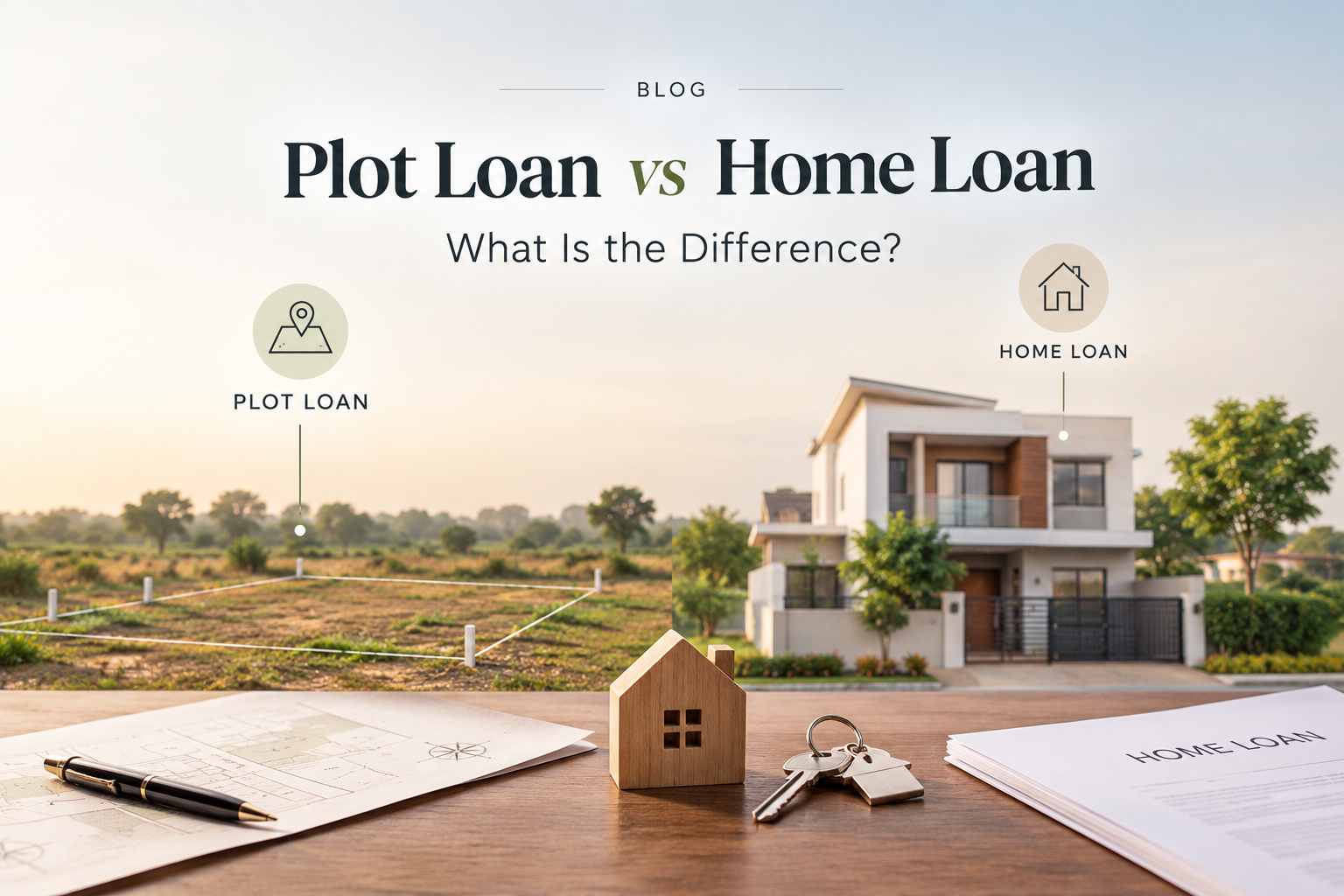
Plot Loan vs Home Loan: Why the Difference Matters
What separates them is quite straightforward. A plot loan is primarily used to buy land for residential purposes while a home loan can be used to acquire or build residential premises. This is essential because not all land plots can be financed with any type of housing loan. Lenders usually check the property documents like the title, layout map, land-use type and location when approving loan requests. People’s future plans are important. A person who buys a plot and intends to build a home in the coming years will use more suitable financial instruments than someone who buys a finished property.Plot Loan vs Home Loan: Quick Comparison
| Comparison Point | Plot Loan | Home Loan |
|---|---|---|
| Purpose | Purchase of a residential plot | Purchase or construction of a residential property |
| Can you buy only land? | Yes, subject to lender and property eligibility | Generally designed around a residential property or construction |
| Down payment | Own contribution required; amount varies by lender | Own contribution required; amount varies by lender |
| Loan amount | Depends on property value, income, credit profile and lender policy | Depends on property value, income, credit profile and lender policy |
| Interest rate | May be priced differently from a standard home loan | Based on the lender's applicable home-loan pricing |
| Tenure | Depends on lender and borrower profile | Depends on lender, borrower and loan type |
| Documentation | Borrower income documents plus property and approval documents | Borrower income documents plus property, legal and technical documents |
| Construction condition | Some lenders may require construction within a specified period | Construction is part of financing when the loan is specifically for construction |
| Tax treatment | Buying land alone does not automatically provide the same housing-loan tax treatment | Certain housing-loan benefits may apply depending on purpose and applicable tax rules |
| Typical use | Buy a plot and construct later | Buy or construct a residential property |
The exact terms are lender-specific. For example, lenders may offer separate land-purchase and land-plus-construction products rather than treating every property purchase under one loan structure.
What is a Plot Loan?
A plot loan involves using financing to buy an eligible residential plot where you plan to eventually build a residential property on the lot. When offering this kind of loan, lenders usually consider your financial situation along with details about the plot itself. They will typically evaluate things like your income level, your credit history and your ability to repay. When evaluating the plot, they’ll want to see the title deed, get the necessary approvals for the development, look at the layout and any other relevant legal documents. If you’re interested in purchasing land now and then constructing a house in the future, a plot loan could be the right option for you. But before committing, be sure that there aren’t any specific construction requirements tied up with the terms of your loan.What Is a Home Loan?
Most home loans are taken out for purchasing/constructing a residential property. This can be for buying a completed house, under-construction property, or constructing your dream home on an eligible plot. The disbursement could happen in stages if you take a home loan with an emphasis on construction (this would depend on your lender & their respective products). You’ll need to check up on the exact procedure as there might vary depending on lenders & their respective properties & the terms of loan agreements between them. Unlike these other types of financing, which focus specifically around acquiring vacant land instead, you’ll want to know exactly what kind of purposes they cover before making comparisons about things like interest rate levels & EMI figures.Can You Get a Home Loan to Buy a Plot?
Some lenders have plot/purchase financing as part of their housing-finance product offering. However, the terminology varies from lender to lender. For instance, HDFC’s published materials separate out plot-purchase vs plot plus construction loans. You need to ask your lender specifically if their product can be used to finance this particular plot, if there are any further requirements (like construction) and the associated time line.Plot Loan vs Home Loan: Eligibility and What Banks Check
The first thing that needs clarification here is this – what factors decide your plot loan eligibility? Well, there are essentially two broad categories – You (as a borrower) and Property (you wish to buy). Firstly, about you – Lenders might look into your income, employment / business profile, age, credit history, your current EMIs, your banking records etc. So if you are salaried, they would ask for your salary and employment records, whereas for self employed people, business, income tax, and various financial docs will be required. So, depending upon your source and type of income, their requirement differs too. Then, about the Property – They usually require you to provide them with some key details regarding the property. This includes title, approved layout, relevant NA or land use doc, encumber details, necessary development permissions, all the legal & technical papers, and more. Moreover, the lender’s approval process could also involve valuation & legal verification. For example, two buyers buying very similar plots could be given conflicting outcomes based on differences in income, credit profile, existing obligations or documentation.How Much Plot Loan Can You Get?
How much you can borrow isn't decided just by the plot price. Lenders might look at the property worth, your earnings, current money duties, credit record, ability to pay back plus their specific loan-to-value rules and underwriting guidelines too. For instance, if a qualifying plot costs 20 lakh rupees and the lender asks the purchaser to put down 6 lakh rupees personally, then the leftover 14 lakh rupees might represent the funding need, pending approval by the lender for that sum. This serves merely as an example, not a fixed funding ratio. The real approved sum might be less or arranged otherwise. Plot Loan vs Home Loan: Interest Rate, EMI & Total Cost The plot loan interest rate might differ from the rate offered for a standard home loan. Rates can also vary based on the lender, borrower profile, loan product and current pricing. This is why looking just at the stated interest rate may offer a partial view. A purchaser ought to check the handling charge, appraisal or lawyer fees if needed, initial deposit, monthly installment, loan term, early payoff rules and overall sum paid back. An seemingly less high rate might not actually imply a reduced total expense when extra fees or terms vary. For someone buying land, building time can change future costs too. When using a plot-and-build deal, the bank might set a window where work starts or ends. Certain banks could adjust rates or fees if needed building fails inside that set time. Terms from one lender cannot be thought to fit everywhere always. Prior to selecting a loan, one should contrast the overall expense of borrowing rather than merely examining the stated interest percentage.What Documents Are Required for a Plot Loan?
he typical plot loan required can vary from person to person as you will have to demonstrate your ability to repay the loan and source of income to the bank. Documents required for salaried applicants can range from proof of address, and identity documents to salary slips, bank statements and income documents. Documents for self-employed applicants could be business proof, income-tax returns, financial statements and bank documents. The documents required for any other sources of income would vary accordingly. Property documents are also necessary. The lender may require sale agreement, title documents, approved plan, NA/land-use documents, encumbrance related records, previous ownership documents and other approvals for legal and technical due-diligence depending upon the nature of the transaction. The last checklist should always originate directly from the lender doing the application.Why Plot Approvals & Documentation Matter for Loan Approval
The buyer doesn't get approved for a loan just because of the income. Furthermore a lender will also require some assurance that the site to be funded is capable of being used as security from a legal and technical perspective. It is for this reason that title validation, approved layout plans and land-use consents might form part of the procedure. From the buyer's point of view, this sends a practical message: see what documents exist on the property before buying it. Don't wait until the time when the mortgage or the selling process is being processed to learn that a document, permit or condition does not correspond.Plot Loan vs Plot + Construction Loan
There are three common situations to understand. Option 1: Purchase a plot first, then construct It is possible that the buyer may choose to take a plot loan, and afterwards take a construction loan once construction begins. Option 2: Purchase the plot and then apply for construction finance: The applicant, the project and the property documents might be reevaluated by the lender at that time. Option 3 - Plot+Construction: In this category, the flat-buyer is financing the land purchase as well as the construction through a linked product. Some lenders do have this scheme, but their construction schedule, disbursement process, interest treatment and conditions may differ. For instance, HDFC has a dedicated list of construct+plot schemes. Should you wish to start several years down the track, be sure to inquire what the impact of a delay on your start date will be to the lender. Some contracts do have a maximum period for construction with increased interest or repayments if this period is exceeded.Step-by-Step: How to Apply for a Plot Loan
Begin by assessing whether you qualify by virtue of your income, credit history, and debts. Then choose a plot which serves your purpose and check its documentation thoroughly before investing. Consider other factor such as down payment required, tenure, processing charge, construction restrictions and rates of interest. Then decide between different lenders based on such factors. After filling of borrower as well as property documents, the loan provider can do technical as well as legal verification. The lender provides the sanction to the applicant if the application is sanctioned and also collects the necessary loan papers. The disbursal is then executed as per the loan agreement and transaction needs.Common Mistakes to Avoid
One of the mistakes is to think that any all residential plot will be eligible for a loan. Or the mistake is to choose a plot first and go through the documents only after paying token/advance. Similarly borrowers should not compare lenders solely on the interest rate. The actual cost of borrowing can be affected by processing charges, valuation fees, legal fees, down payment and building conditions. One more errors are overlooking your own contribution required. Likewise, remember that securing financing doesn't always imply that all the time that the house is right for your requirements. Your individual legal and financial due diligence continues to be essential.Which Loan Should You Consider?
The appropriate loan depends on your purchase plan.| Situation | Loan Type to Explore |
|---|---|
| Buying a residential plot and building later | Plot Loan |
| Buying a completed house | Home Loan |
| Buying an under-construction home | Home Loan |
| Buying land and financing construction | Plot + Construction or lender-specific option |